
Why Bedford Is Perfectly Placed for Solar PV Today
Bedford and the wider Bedfordshire area enjoy a strong mix of daylight hours, open roofscapes, and rising demand for home energy independence—an ideal combination for solar panels to deliver impressive returns. With around 1,500–1,600 hours of sunshine per year and modern high-efficiency modules, a typical 3.5–5 kWp system in the region can generate a significant share of a household’s annual consumption. What’s more, energy prices have driven many homeowners and businesses to look for stable, long-term savings; by offsetting daytime usage and capturing surplus energy for later, solar PV delivers exactly that.
The UK’s Smart Export Guarantee (SEG) further improves the equation by paying you for excess electricity exported to the grid. While export rates vary by supplier, pairing solar with a battery storage unit enables you to reduce reliance on peak-time tariffs, smooth out cloudy periods, and make better use of your self-generated power. In Bedford’s mix of Victorian terraces, post-war semis, and newer developments, there’s usually a solid design pathway—whether that’s a compact south-facing array, an east–west split for longer daily generation, or subtle all-black modules to suit conservation-minded streets.
Planning is generally straightforward because most rooftop systems fall under Permitted Development Rights, provided they meet basic guidance on roof line, positioning, and glare. Flats and listed buildings may require additional steps, and local roof types—clay tiles around Biddenham and Bromham, slate in older Bedford townhouses, or membrane on light industrial roofs near Elstow and Cardington—call for the right mounting approach. A professional survey identifies fixing points, assesses shading from chimneys or dormers, and confirms whether string inverters or microinverters will make the most of Bedford’s real-world roof conditions.
When residents search for high-quality Solar Panels in Bedford, they’re often looking for more than panels alone. They want clear guidance on payback (typically within 5–10 years depending on usage and tariff), a trusted design tailored to the property, and accredited workmanship that meets the latest safety standards. With a well-specified system, households can often cut grid imports by 50–80% across much of the year, and local businesses can shave off a large share of daytime operational costs while strengthening their sustainability credentials.
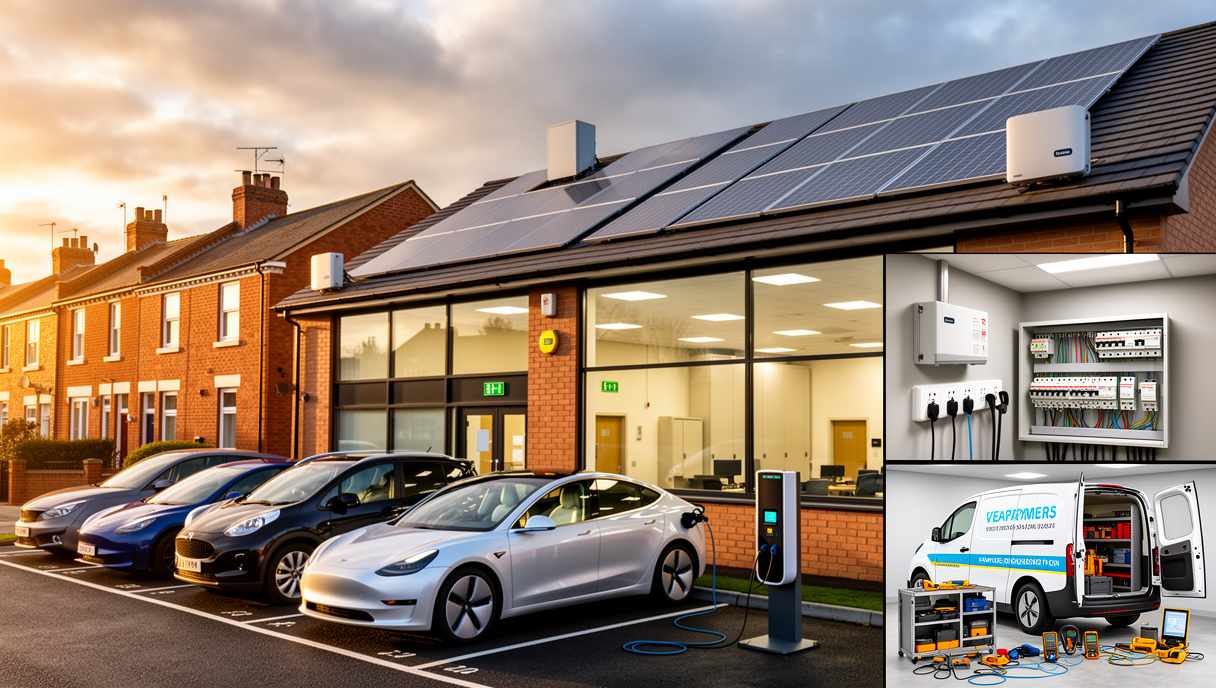
Designing the Right System for Your Home or Business
Getting solar right in Bedford starts with a thoughtful design. Roof orientation and pitch shape the production curve: south-facing arrays maximise total yield, while east–west layouts provide a longer, flatter generation profile that often matches family or commercial schedules better. Shade mapping is essential in neighbourhoods with mature trees or skylights; where partial shade is a factor, microinverters or panel-level optimisation can prevent one shaded module from dragging down the whole string.
Panel technology has advanced rapidly. Modern n-type modules with half-cut cells and anti-reflective glass deliver robust performance in Bedford’s variable weather, extracting more energy in low light while staying cooler in summer. Many homeowners prefer black frames and backsheet for a subtle aesthetic that blends into slate or dark tile roofs, while businesses on flat roofs often use ballasted frames to avoid penetrations, balancing wind loading, weight, and drainage considerations. A structural check ensures rafters or purlins can accommodate loads, with mounting systems selected to match tile types common across Bedford, Kempston, and surrounding villages.
Inverters are the heart of the system. String inverters provide excellent value, simple maintenance, and efficient conversion. If the property has complex roof planes or spot shading, microinverters or DC optimisers maintain high output and offer module-level monitoring. Battery storage—typically 5–10 kWh for homes and much larger for commercial sites—lets you time-shift solar into evenings, reduce peak-rate imports, and keep essential circuits running during grid interruptions with a compatible backup setup. Hot-water diverters can also capture surplus energy by heating cylinders, another smart way to lower gas or electricity use.
Integration matters too. Bedford drivers adopting EVs can install charge points that favour surplus solar, effectively “fueling” commutes with sunshine. Smart meters and tariff-aware systems enable dynamic control as energy markets evolve. On commercial premises, three-phase systems, export limitation (where required), and load profiling ensure solar directly supports machinery, refrigeration, or office HVAC during core hours. Across both residential and commercial projects, look for robust product warranties (often 20–25 years on panels) and workmanship guarantees, plus compliance with the latest wiring regulations and renewable installation standards for safety, performance, and insurance peace of mind.
Installation, Approvals, and Real-World Results in Bedford
A smooth solar journey in Bedford typically follows a clear pathway: discovery call, on-site or remote survey, and a bespoke proposal that models generation against your usage patterns. The survey confirms structural details, cabling routes, and the best locations for the inverter and battery—usually near the consumer unit to shorten DC or AC runs and simplify isolation points. From there, your installer manages grid notifications: most domestic systems up to 3.68 kW per phase fall under G98 rules; larger arrays or commercial systems may require a G99 application with the local Distribution Network Operator (in this region, that’s typically UK Power Networks), including export limits where necessary.
On installation day, scaffolding protects access and roof edges, while mounting rails align to the rafters or appropriate fixing points. Panels are clamped securely, cables neatly dressed, and DC circuits safely routed to the inverter. Electrical works include dedicated circuits, RCD/RCBO protection where required, surge protection according to risk assessment, and clear labelling in line with the current wiring regulations. Once powered, the system is commissioned, tested, and configured with monitoring so you can view real-time and historical production through a user-friendly app. You’ll receive a handover pack with datasheets, certificates, and guidance on optimal usage.
To earn SEG payments, you’ll need an MCS certificate for the installation and a compatible smart meter. Your installer can guide you through supplier sign-up, meter checks, and any export limits. Maintenance is generally light: visual inspections, app-based performance alerts, and occasional cleaning if dust or bird droppings reduce output. In Bedford, rain cleans most roofs naturally, though flat or shallow-pitched arrays may benefit from periodic rinses, especially near industrial zones or busy roads. Winter yields are lower, but spring and summer frequently exceed expectations, and batteries help stretch solar into night-time use.
Local results illustrate the potential. A Kempston semi with 4.2 kWp, panel-level optimisation, and a 7 kWh battery saw daytime grid imports collapse, with around two-thirds of annual electricity now self-supplied. In Brickhill, a terraced home added a hot-water diverter, slashing gas use for showers and washing up through sunny months. On the commercial side, a 50 kWp array for a Bedford warehouse reduced daytime electricity costs substantially, with export limitation protecting the grid connection while still delivering a healthy payback. For every scenario—Victorian townhouse, new-build in Wixams, village bungalow in Wootton, or a light industrial unit in Elstow—the right combination of solar panels, inverter technology, and battery storage unlocks lower bills, lower carbon, and a resilient energy strategy tailored to Bedford’s real-world conditions.

Porto Alegre jazz trumpeter turned Shenzhen hardware reviewer. Lucas reviews FPGA dev boards, Cantonese street noodles, and modal jazz chord progressions. He busks outside electronics megamalls and samples every new bubble-tea topping.